Introduction to Open Science Communities
1. The role of communities in the transition to Open Science
Open Science1 (OS) encompasses a large and ever growing set of practices that make scholarly output (publications, data, code, workflows, etc.) more accessible, transparent, reliable, and inclusive. The rationale behind any of these practices is that openness increases the quality, efficiency, and impact of science. While some of these practices are by now more widespread (e.g., Open Access publishing), and there is an international recognition of open science and its guiding principles, many aspects of open science are still far from being mainstream (e.g., open data and preprints). If you are reading this toolkit, you are probably aware of many of such practices and their benefits to science and society.
At first glance, the transition to OS can seem rather easy to accomplish. Why would people not embrace this great new set of practices? In reality, it requires nothing less than a profound cultural shift in academia. As articulated by Brian Nosek, a culture change needs a set of key ingredients that can be represented as a pyramid.
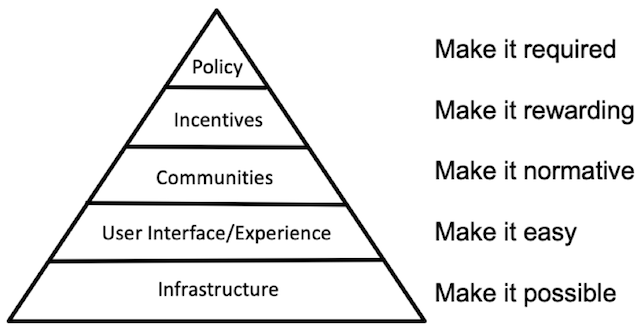
The pyramid of culture change. Image by Brian Nosek (licensed under CC BY-ND 4.0), reproduced from the blog post Strategy for Culture Change.
At the top of this pyramid sits Policy. For a cultural shift towards OS in academia, policies are needed to promote OS and to assure that institutional incentives are aligned accordingly. At the bottom of this pyramid, we find the required infrastructure. Having a reliable, flexible, and user-friendly infrastructure is essential for putting open science to practice, e.g. platforms that allow for collaborative workflows to store and share materials, data, code, and other output. Despite recent policies and available infrastructure, we are still awaiting a true cultural shift. What is holding us back?
The challenge lies within the middle layer of the pyramid, the communities that make OS normative. The importance of community engagement as a driving force for change becomes clear when the layers descibed above are mapped to different phases of tranision, as described by the Diffusion of Innovation Model.
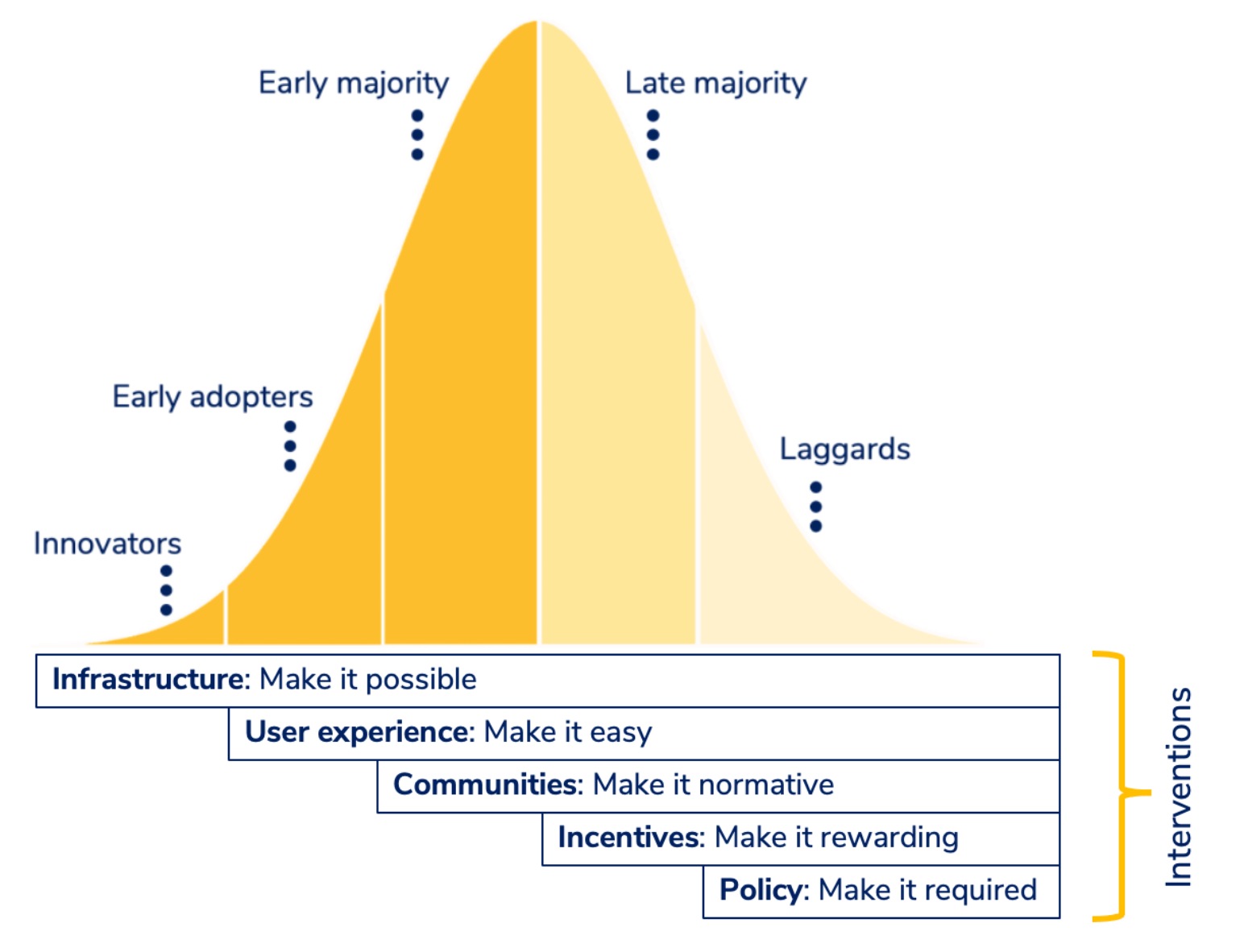 Image by Anita Eerland, based on original image by Brian Nosek
The Innovation Adoption Lifecycle, or Roger’s Bell Curve, indicates stages any innovation typically goes through: Innovators, Early Adopters, Early Majority, Late Majority, Laggards, mapped to the drivers for culture change. At the moment, we are still in a phase where mostly 'Innovators' and 'Early Adopters' use OS practices. They have a strong intrinsic drive and as long as the infrastructure is available, they will go for it. For OS to become common practice, we also need to engage the 'Early and Late Majority'. For this group, community norms are the main driver. To get them on board, OS practices need to be visible and accessible.
** This is where Open Science Communities (OSCs) come into play! **
OSCs are bottom-up learning communities designed to appeal to a large proportion of researchers, connecting frontrunners to newcomers to OS. OSCs show the prevalence of OS practices and explore the obstacles and requirements for newcomers to make their workflows more open..
To instantiate a global change towards OS, we need many local OSCs, all around the globe. It is with these objectives in mind that we created this toolkit, to inspire and enable you to create and maintain a local OSC. The key to accelerate the transition towards OS is in your hands.
2. Our format for Open Science Communities
The format of OSCs that we introduce in this toolkit is a bottom-up learning community comprising members of various scientific disciplines and career stages. The main target audience of OSCs are researchers, but research support staff and research managers are also valuable members of our communities. Community members are associated with universities, universties of applied science or other research performing institutes.
Our vision and mission are:
Vision and Mission
Open Science improves the quality, accessibility, and efficiency of science, but is not yet the norm in research. While pioneering scholars are developing and embracing Open Science practices, the majority sticks to the status quo. To move from pioneers to common practice, we need to engage a critical proportion of the research community.
Open Science Communities provide a place where newcomers and experienced peers interact, inspire each other to embed Open Science practices and values in their workflows, and provide feedback on policies, infrastructure, and support services.
Together, we make Open Science the norm!
The above mission can be broken down into practical aims:
Aims
- Onboard newcomers to Open Science
- Make the prevalence of OS practices more visible
- Increase engagement in Open Science practices
- Serve as a breeding ground for Open Science initiatives
- Provide input to policy, infrastructure and support services
- Foster interactions between researchers and societal stakeholders
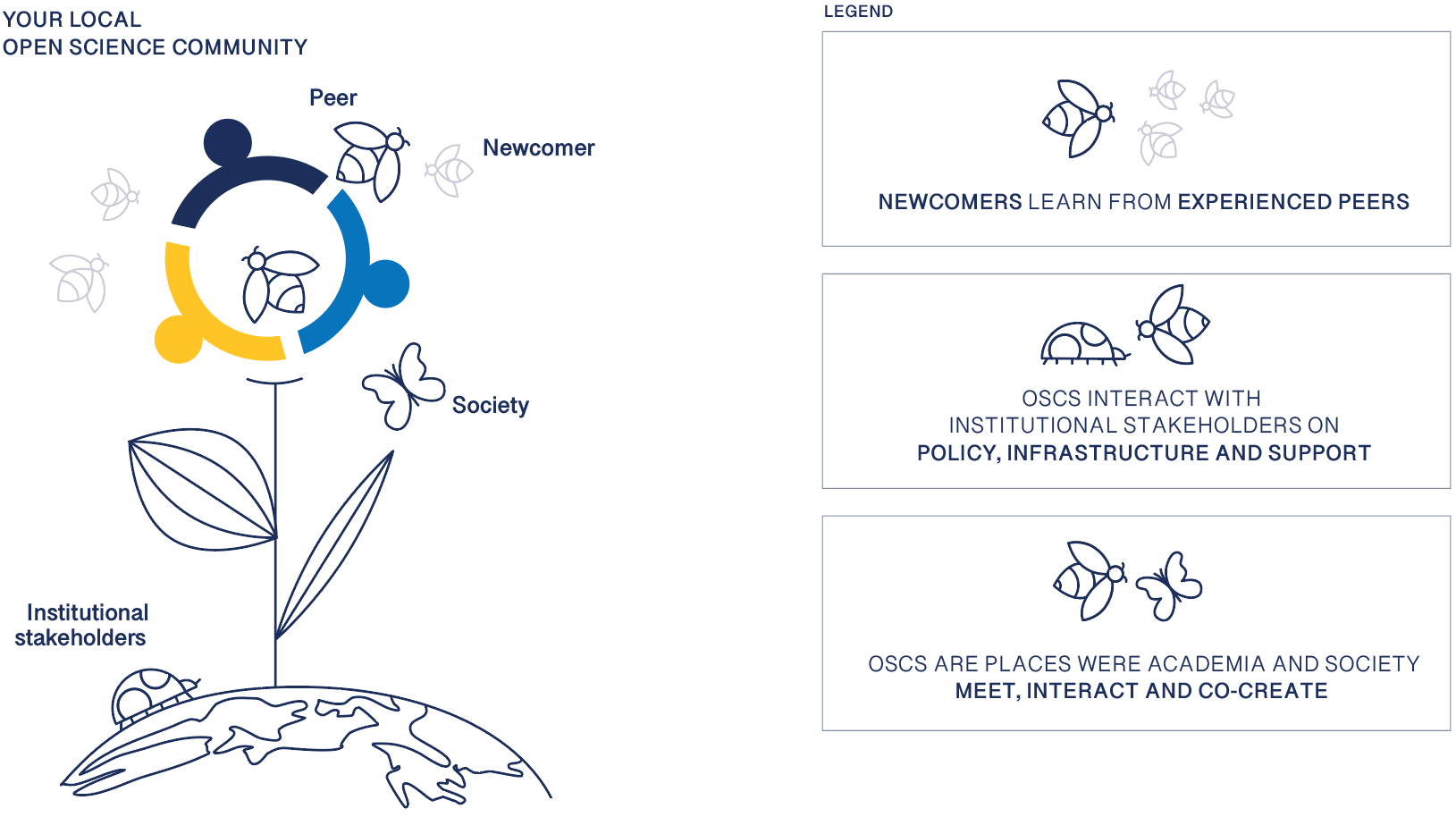 The main purposes of an Open Science Community (see legend).*
Aim #1 - Onboard newcomers to Open Science
The core aim of an OSC is to welcome newcomers to OS and to provide a platform where they can learn from their peers and identify ways to overcome bottlenecks when transitioning to (more) open workflows. An OSC is a learning community: you do not need to have any experience with OS to join the community, or commit to such practices upon joining. What unites community members is their interest in OS.
To engage newcomers, it is crucial for them to know of the existence of the community. Also, newcomers need to be attracted to the community. They need to feel at home. It is key here to strike the right tone and provide appropriate onboarding procedures.
Aim #2 - Make the prevalence of OS practices more visible Many people are often already engaged in OS - sometimes even without realising it -, but their efforts are not visible to their peers. OSCs are places where the prevaling OS practices are given a stage to inspire peers. By doing so, OSCs contribute to a shifting norm towards OS.
Aim #3 - Increase engagement with Open Science practices
Increasing engagement with OS practices is central to our mission. Our main strategy is to facilitate knowledge exchange among peers. In the Section Grow and Inspire, we provide several practical examples of formats that this.
Aim #4: Serve as a breeding ground for Open Science initiatives
The success of a community depends on the contributions of and interactions between its members. It is therefore important to enable members to start their own initiatives within the community (or across communities). These initiatives can be facilitated by providing guidelines, announcing them on the website, newsletter, and social media, and, if possible, allocating budget. Instead of developing new initiatives, members can also adopt existing formats that were proven successful in other institutions (e.g., other OSCs).
Aim #5: Provide input to policy, infrastructure and support services
One of the key features of an OSC is that it is organized bottom-up and operates independently. That means that the community is a self-steering organisation that does not receive instructions, targets, or tasks from other parties. However, OSCs should not operate in isolation. Policy describes what is required, desired, and incentivised; infrastructure determines what is possible; but the community determines how things are done in practice. To facilitate a smooth transition to OS, all stakeholders need to collaborate. Therefore, community coordinator(s) strive to increase connections with colleagues at leadership positions, in particular those involved in institutional policies, infrastructure, and support.
Aim #6: Foster interactions between academia and society
For science to be truly open, it is important that science is not only open to colleagues in academia, but also open to societal stakeholders, such as civil societies, civilians, patients, politicians, and industry. Open science thus also means engaging with these stakeholders in a bi-lateral and meaningful way, for instance by making science more accessible, providing press-abstracts and summaries for the layperson, involving the public in decisions of what to study (e.g., the ‘Nationale Wetenschapsagenda’ in the Netherlands), and achieving a common goal through Citizen Science. OSC are places where researchers can learn how to interact with societal stakeholders in all stages of the research cycle.
🎥 By the end of this video, you will
- Understand the Power and Principles of Open Science Communities (as described in the text above)
3. History and Achievements of the Open Science Communities
To get a taste of how an OSC can evolve, let’s have a look at how the network of OSCs started. The first OSC was the one in Utrecht in the Netherlands (OSCU), started in 2018 by two researchers with a passion for OS (Anita Eerland and Loek Brinkman). They started out by making the prevalence of OS practices at their university more visible, by asking colleagues that were engaged in OS to join the community and listing their OS expertise on the community website. In addition, they recruited members that were interested in OS, but did not have prior experience with it. These members could then contact their more experienced peers to learn more about certain OS practices. Moreover, OSCU members received a monthly newsletter and the founders started to showcase the community around campus and on social media. Community members would receice stickers to put on their office doors or laptops, to signal to others that they were part of this community. Over time, the number of members increased and OSCU started organizing a series of workshops whose topics were based on a survey amongst its members. After a year, OSCU received funding from Utrecht University to further develop and sustain its activities, which led to the appointment of Faculty Ambassadors to promote the community in their respective faculties, which lead to many new members from the respective faculties.
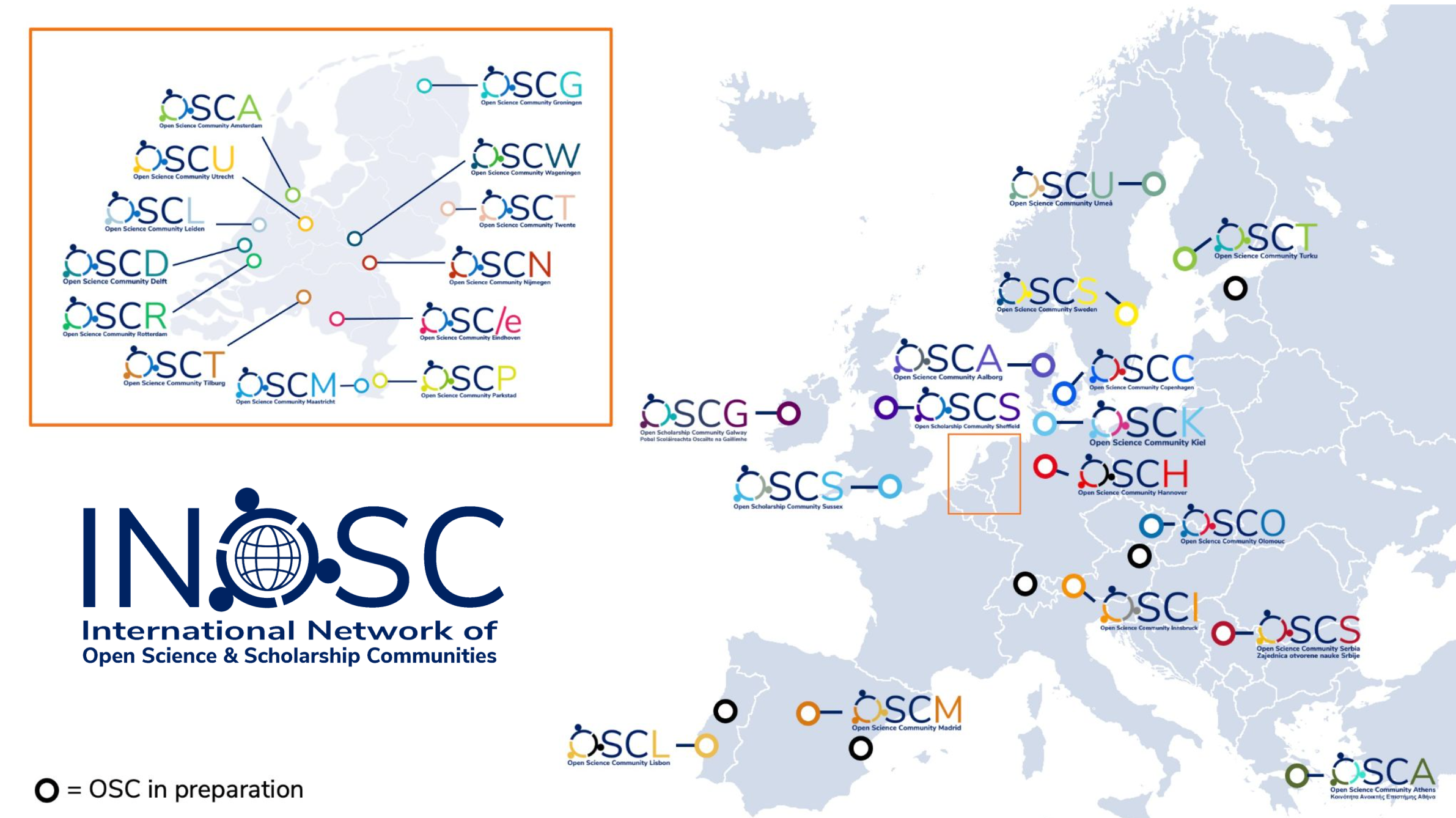
In addition, the founders created a step-by-step tutorial describing how they started OSCU, to help colleagues at other universities start a similar initiative at their university. Within a year, colleagues from several Dutch universities started their own local OSCs, operating under a similar acronym and logo and sharing a set of Guiding Principles and a Code of Conduct. Rapidly, OSCs stated to sprout in all Dutch university cities, and in several places universities of applied science and other research institutes joined local OSCs. The Dutch Network of Open Science Communities (OSC-NL) has since provided input to national Open Science policies and has been recognized by the National Open Science Council as an essential part in the transition to Open Science in the Netherlands, which resulted in national funding for all Dutch OSCs.
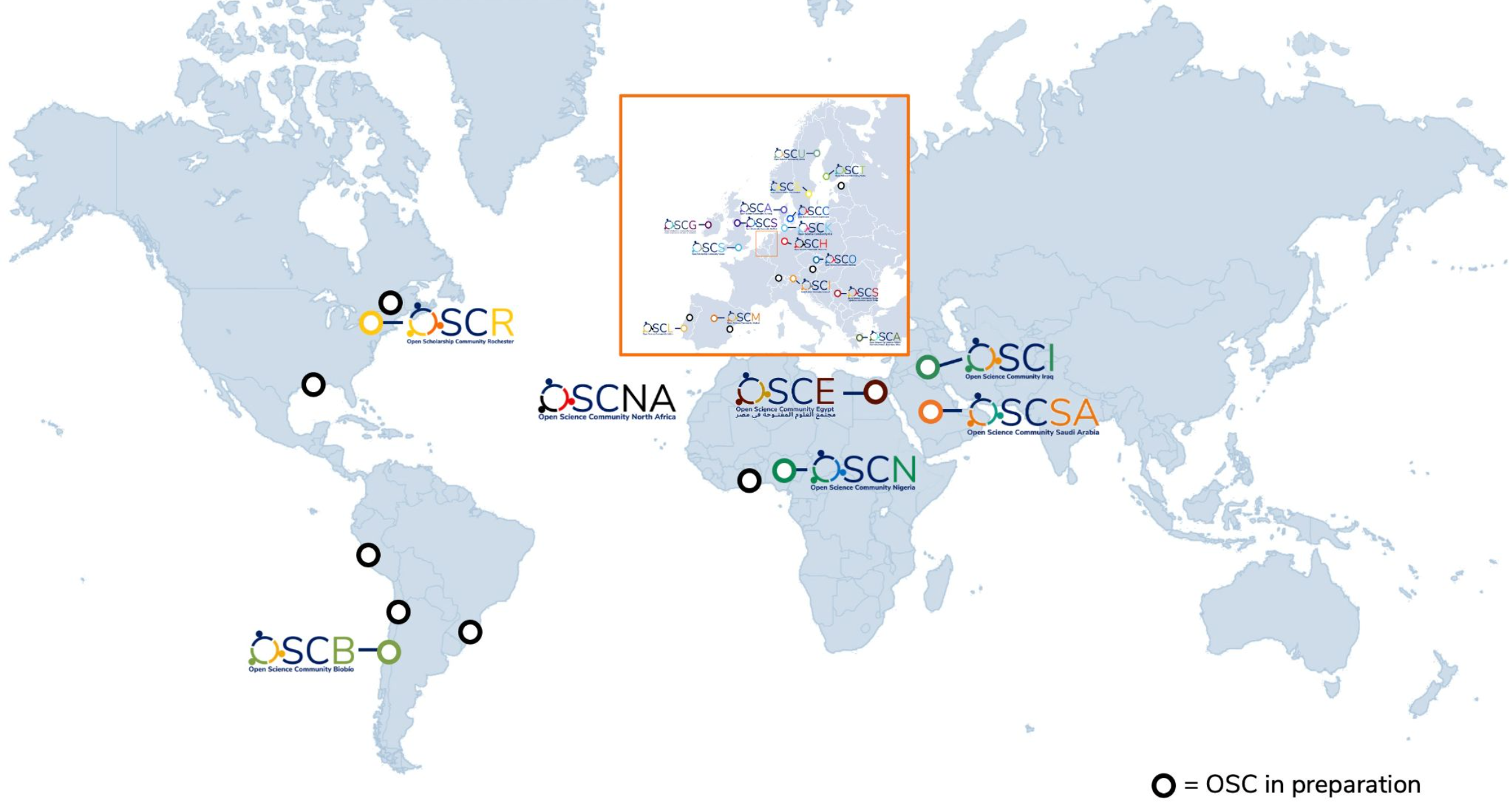
The format of OSC was also presented at international conferences, and colleagues abroad started setting-up OSCs in their respective countries. In 2020, coordinators of several OSCs published a whitepaper on the role of OSC in the transition to Open Science. European fundings was acquired from EU funded projects AURORA RI and Skills4EOSC to develop and deliver an online training program. This OSC Incubator Program, to train colleagues to set-up their own local OSC and connect to the International Network of Open Science Communities (INOSC). INOSC now consists of over 50 local OSCs in Europe, United States, Latin America and Africa, with over 2500 members, ready to put Open Science to practice!
Footnotes
-
The term "science" is used here in its broadest sense and includes fields such as the humanities, social sciences and engineering; that is, it more suitably refers to any form of scholarship. ↩