
Stage 1: Prepare and Launch
Objective
- Complete the 10-step checklist to launch your OSC
The Minimum Viable OSC
Starting an OSC first and foremost means getting people together and facilitating interactions amongst them. In order to get your OSC off the ground, there are a few additional aspects that you need to take off. Together, these are listed here in the 'Minumum Viable Community Checklist'
-
1. Meet with the INOSC board
-
2. Establish a Core Team
-
3. Design your Logo
-
4. Write your Community Statement
-
5. Implement our Code of Conduct
-
6. Find Initial Members
-
7. Organise Community Activities
-
8. Create your OSC website
-
9. Draft a first version of your OSC Master Plan
-
10. Launch your OSC!
1. Meet with the INOSC board
So, you want to start an OSC. Great! The first thing to do is to verify that your idea of an OSC is aligned with the values of the INOSC community. Let's schedule a short call to get to get to know each other, provide additional context about INOSC, verify that our are in alignment and help you out. You can reach out to the INOSC Board via email (board@osc-international.com)
Before the call, please check out the INOSC Guiding Principles and Code of Conduct. Here we provide a general description of the aims and goals of our network. These shared principles and Code of Conduct are what defines us as a network, while leaving room for each OSC to decide how they operationalize these principles, based on their local context.
INOSC Guiding Principles
- Open Science/Scholarship Communities are bottom-up platforms to exchange knowledge and knowhow on open science practices
- Researchers are the main target audience of OSCs, but students, researcher supporters, and others that are interested in (conducting) research are also welcome to join the community
- No prior knowledge is required to be part of the community, nor are members in any way required to commit to certain open science/scholarship practices
- OSCs organize, promote, and facilitate open science/scholarship events to (1) learn about and discuss open science/scholarship practices, (2) share open science/scholarship knowledge, and (3) build professional networks.
- Events are open to both members and non-members, and are free-of-charge, if possible
- Attendees and organizers of events organized by OSCs should adhere to the Code of Conduct
- OSCs promote critical discussions of pro’s and con’s of open science/scholarship practices. We refrain from being normative or condescending, and do not tell others what to do. Respect for each others’ workflows and decisions in this regard is critical.
2. Establish a Core Team
The first thing you need is (at least) one Community Manager, who takes the initiative to start an OSC. This could be you! Looking at the people that have started local OSCs so far, we can identify the following profile:
- Passionate about Open Science
- Early to mid-career researcher (PhD student / Associate professor)
- Enthusiastic
- Outgoing
- Optimistic
- Enable to inspire others
- Inclusive
- Innovative
- Team player
- Well connected within the university and/or able to establish new connections (e.g., with deans, librarians, research support offices, various councils, etc.)
- Willing to try and fail (and try again!)
Obviously, this does not mean that only individuals with the aforementioned characteristics are suitable to become Community Managers. In our experience, it is more sustainable (and much more fun!) to start with more than one Community Manager. Judging from our experiences so far, we recommend two Community Managers who are available for about 2-4 hours per week. Look for like-minded colleagues who want to co-create and co-lead an OSC with you. In the start-up phase, Community Managers are often self-appointed. However, it is also possible for Community Managers to be selected based on an election process amongst community members. You can find more information about this in the section on Governance.
It is also possible for people who are not active researchers (e.g., research support staff or librarians) to initiate and facilitate an OSC. This has been the case, for example, in Rotterdam in the Netherlands (OSCR) and Galway in Ireland (OSCGalway)1. In those cases, active researchers are included in strategic decisions related to the selection of topics and prioritization of activities. One of the main aspects that make OSCs attractive for (new) members is that the community is bottom-up: for scholars, by scholars. OSCs operate in parallel of – but independently from – local policies or initiatives. It is important to stress this bottom-up nature when representing the OSC, in particular if Community Managers are not active researchers themselves.
While setting up an OSC requires substantial commitment and time investment, our experiences have been very rewarding. As Community Managers, we have greatly extended our professional networks across all layers of the university, including rectors, deans, support offices, and librarians, thus increasing our influence on policy and infrastructure. On a personal level, we have acquired useful transferable skills, such as project management, community management, and leadership. Most importantly, it is extremely rewarding to co-create large-scale solutions with inspiring and like-minded colleagues, being part of something bigger than yourself, for the betterment of science and society.
3. Design your Logo
Every community is unique, but we share a common basis. This is reflected in the design of our logos. Striking a balance between uniformity and flexibility, we have set-up a Style Guide where we specify how you can create the logo for your OSC based on a template. There is consistency in the naming, font and base colours, but each OSC can choose two colours to customize their logo.

When in doubt, you can reach out to Anita Eerland (anita.eerland@ru.nl), who is in charge of the visual identity of INOSC.
4. Write your Community Statement
A Community Statement is a short description of your community. It describes the purpose of the community, who it is for, its values and gives an impression of 'vibe' of the community.
🎥 In this short video, Tanya will help you out in writing your Community Statement (based on materials from the Community Canvas Guidebook).
Here we invite you to describe your community by first answering 10 guiding questions about your OSC (to be).
- [PURPOSE] Why does the community exist?
- [PURPOSE] What does the community hope to achieve?
- [MEMBER IDENTITY] Who is the community for?
- [MEMBER IDENTITY] How will it affect the lives of members if they are part of this?
- [VALUES] What is important to us as a community?
- [VALUES] How do we want our members to treat each other?
- [SUCCESS DEFINITION] How does the community define success?
- [SUCCESS DEFINITION] What does the ideal community look like?
- [BRAND] How does the community express itself?
- [BRAND] How does the community communicate its identity to the world?
The answers to these questions should be reflected in your Community Statement. Need some more inspiration? You can find a collection of Community Statements of OSCs in our network here [link to INOSC Collection of Resources].
5. Implement your Code of Conduct
Within the INOSC we share a Code of Conduct (CoC). Before you start up any activities, it is wise to adjust the generic CoC text to your situation, and to look at the INOSC CoC workflow. This workflow will advise you how to set up a CoC committee for events.
6. Find Initial Members
To kick-off your community, you need a initial group of members. The size of this group is not too imporant, as long as they are engaged. It can be a group of 5-10 people. In the initial stages of an OSC, attracting members is most effective by word of mouth. Talk to colleagues who are interested in OS and/or already have experience with OS practices, and ask them if they are willing to join the community. Note that it matters a lot who your initial members are. If all your initial members are from one faculty, it will be more difficult to attract members from other faculties at a later stage, because they will think that this community is not for them. The same goes for OS expertise. For instance, if you only have OS 'experts' as members, newcomers will be more reluctant to join. Thus, make sure that your initial members are a heterogeneous group.
Recruiting and onboarding members is one of the most important aspects of community management. In the next section ('Grow and Inspire') LINK we will dive more in this topic.
7. Organise Community Activities
In the first stage of your OSC, it is crucial to schedule a line-up of activities for your members. A community thrives by the interaction among its members. A starting point can be to ask members to give talks or workshops on OS topics they have experience with. Bear in mind that these speakers don't have to be experts on the topics. All experiences are valuable to those who are new to the topic. We're all here to learn. There are many other formats other than talks or workshops to stimulate interactions among your members, suchs as study groups, journal clubs and newsletters. These and others will be covered more in-depth in this topic in the next section ('Grow and Inspire'). In addition, this toolkit also provides a collection of best practices and formats that have been succesful at existing OSCs for your to browse through.
8. Create your OSC website
A website is an indispensable tool for online visibility of your OSC. On the website, OSCs advertise their activities and display the names and skills of community members via personal profile pages.
While you are free to create the website for your OSC in any way your like, the following elements are required:
- A homepage with the Community Statement of your OSC
- A section with the INOSC Guiding Principles and Code of Conduct
Other features you may consider for your community website are: (1) A section with names and/or profiles of community members (2) a news section for OS developments; (3) an agenda section for OS events; (4) general information about OS; or (5) a page to feature activities and initiatives of your members.
Having a section with names and/or profiles of community members is a feature that most OSCs have included in their websites and is highly recommended. Having (familiar) faces one your website send a strong signal that OS is widely supported and thereby contributes to norm setting. It also lowers the barrier for new people to join your OSC.
The INOSC website provides an overview of all pages of local OSCs. OSC websites have so far been created via Wordpress (e.g., OSC Utrecht), embedded in internal university websites (e.g., OSC Leiden), or R in combination with GitHub Pages (e.g., OSC Nijmegen, OSC Rotterdam). For consistency and to be found more easily, OSCs domain names often follow the form www.openscience-\[CITY\].com (e.g., OSC Groningen).
In the past, INOSC had the resources to assist new OSCs to set-up a community website, free of charge, based on a template website. These websites would be hosted as part of the INOSC website. This service is depending on external sources of funding and may or may not be available at this time. If you are interested in making use of this service, please inform at the INOSC board whether this service is currently available.
9. Draft a first version of your OSC Master Plan
When you have completed the steps described above, you really want to launch your community. But before you do so, it is good practice to start with a first version of your OSC Master Plan. It helps you to think ahead about the next stages of your OSC. The sections of this toolkit focus on various aspect of community management, such as communication and community engagement (Grow & Inspire); governance and sustainability (Foster & Sustain); and (inter)national collaboration amongst OSCs (Connect & Foster). This will help you to reflect on these aspects of your community and write your OSC Master Plan. It is good practice to start with a first version of your OSC Master Plan before the launch of your community. Bear in mind that you will need to revisit and revise your plans as your community grows. Here you can find a template for you OSC Master Plan.
10. Launch your OSC!
When you have checked all the boxes above, it is time to make your community official! A great way of doing this is by organising a kick-off event including, for example a couple of short talks by your founding members on why they are enthusiastic about OS and the community. Ask your initial members to help out by inviting their colleagues to the kick-off event and promoting the community. Current members, preferably at a leadership position, can send out an email to their research group, department, or faculty, to promote the event. Make sure that the event is festive and celebratory, e.g., by decorating the room and offering drinks and snacks. It is also worthwhile to invite someone to take pictures of the event, which can later be showcased in newsletters, social media, and on the community website.
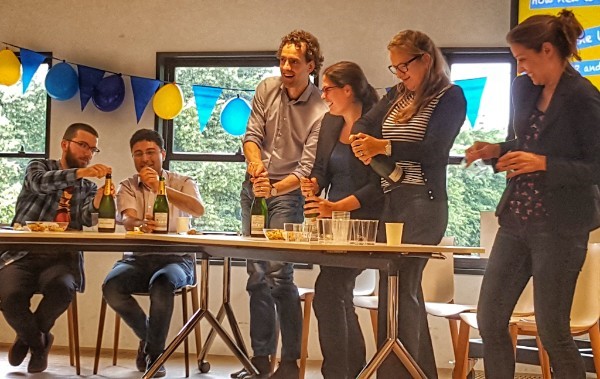
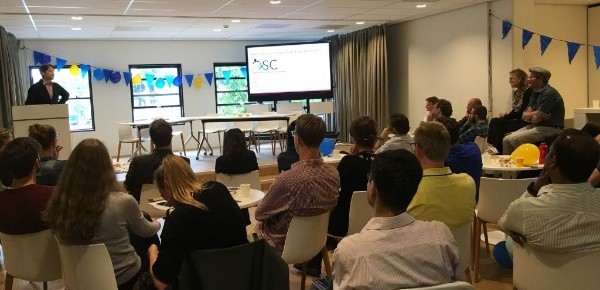
Launch of the very first OSC, back in 2018
Footnotes
-
Note that OSCGalway chose to use ‘Open Scholarship’ instead of ‘Open Science’ in their name to appeal more to colleagues who do not identify with the term ‘Science’. In the Netherlands, Community Leaders have stuck to ‘Open Science’, as this term is more mainstream. As mentioned earlier, the term ‘science’ is used here in its broadest sense. ↩